
Published: October 2026 | Category: Custom Strip Lighting
Quick Answer
When a client needs to backlight a curved computer monitor with a 3D bendable LED strip, the standard 16×16mm profile may not provide sufficient flexibility for the required bend radius. Upgrading to a 20×20mm profile with a precision trace layout allows the strip to conform to the screen's curvature without damaging the PCB or compromising pixel performance.
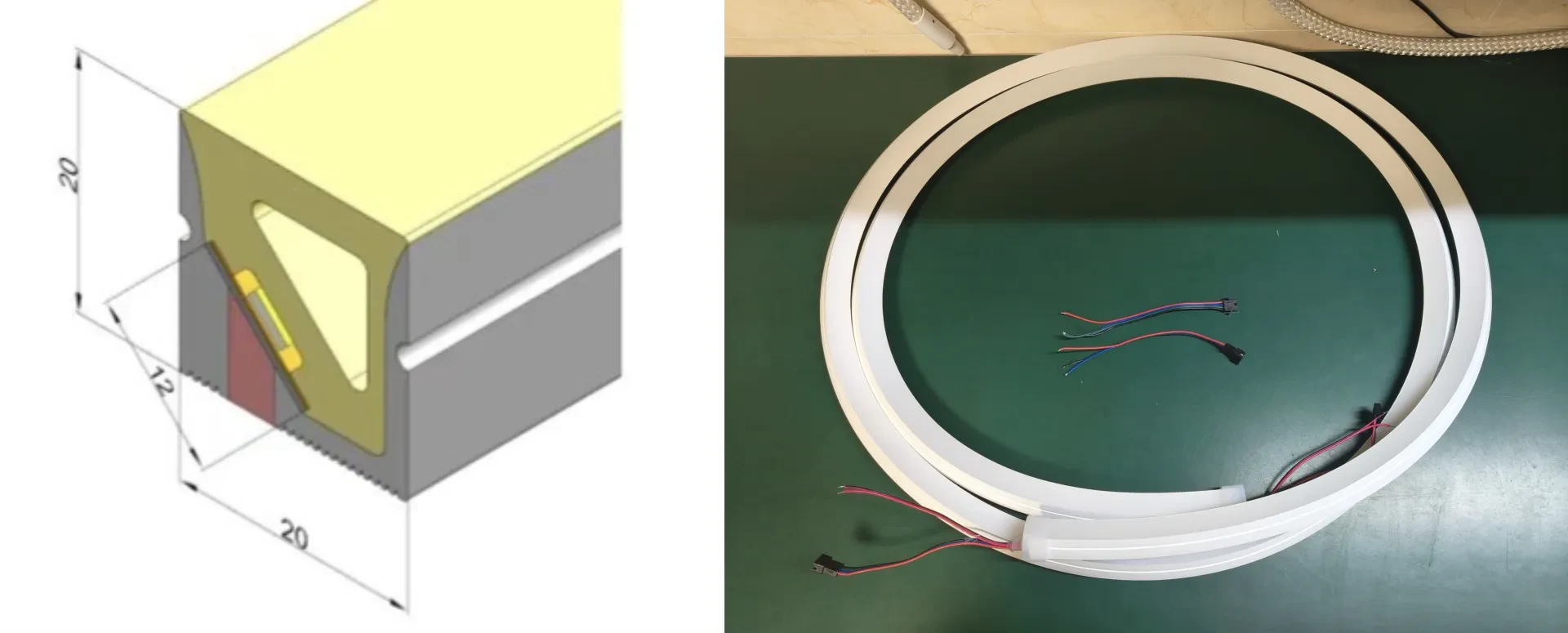
This case study covers the engineering decision and the custom manufacturing process for a 3.4-meter 20×20 3D Flex Neon assembly, delivered to Florian for a curved display project.
Watch the testing video: Unboxing the 20x20 3D Bendable Neon Flex (WS2815 DC12V)
The Client Request: Backlighting a Curved Monitor
Florian approached us with a specific application: he needed a 3D bendable flexible LED neon strip to act as the backlight for a curved computer monitor.
The initial specification called for a 16×16mm 3D flex neon. However, after reviewing the geometry of the monitor's curvature and the required bend radius, our engineering team identified a potential risk.
The Engineering Challenge: 16×16 vs. 20×20 Bend Radius
Profile | Cross-Section | Bend Capability | Risk for Tight Curves |
|---|---|---|---|
16×16mm | Smaller cross-section, narrower internal cavity | Good for gentle curves | High stress on PCB traces at tighter radii |
20×20mm | Larger cross-section, wider internal cavity | Better distribution of bending stress | Lower risk for tighter or continuous curved surfaces |
A curved monitor typically has a continuous, uniform radius. If the 16×16 profile is forced into a bend tighter than its designed limit, the internal flexible PCB can develop micro-cracks, leading to intermittent pixel failure or data line issues.
Our recommendation: Upgrade to the 20×20mm profile. The larger internal cavity allows the PCB to flex more naturally, distributing the mechanical stress across a wider area and ensuring reliable long-term operation.
The Custom Solution: 20×20 3D Bendable Flex Neon
Florian approved the recommendation. The final product was engineered and manufactured to the following specifications.
Feature | Specification |
|---|---|
Product Name | 20×20 3D Bendable Flex Neon |
Model | XXA-3DNEON2020-60D5050RGB-WS2815 |
LED Type | SMD5050 RGB |
Pixel Density | 60 pixels/m |
IC Chip | WS2815 |
Voltage | DC12V |
Power | 14.4W/m |
Total Length | 3.4 meters |
Total Pixels | 204 pixels |
Assembly | Connection cables and end caps pre-fitted |
Power Configuration | Power cables on both ends (dual-end feed) |
Connector Type | SM4P Male & Female (extra connector cable included) |
Why This Configuration Matters
1. WS2815 Chip – Reliability and Break-Point Continuation
The WS2815 is a dual-signal pixel IC. If one pixel fails, the signal continues to the next, preventing a single fault from blanking the entire strip. This is critical for a backlight application where uniform illumination is essential.
2. 60 Pixels/m at 3.4m – High Resolution for Smooth Gradients
At 60 pixels per meter, the 3.4-meter strip contains 204 individually addressable pixels. This density allows for smooth color transitions and precise dimming — important for creating a uniform backlight glow without visible hotspots.
3. Dual-End Power Feed – Consistent Brightness Across 3.4 Meters
At 14.4W/m, a 3.4-meter run would experience noticeable voltage drop if powered from only one end. We specified power cables on both ends, ensuring consistent brightness from the first pixel to the last.
4. Pre-Fitted End Caps and Connectors – Ready to Install
The assembly was shipped with:
End caps pre-installed
Power cables on both ends
SM4P male and female connectors
An extra SM4P connector cable
Florian did not need to solder or source additional parts. The unit arrived ready for integration.
The Manufacturing Process: Small Order, Full Attention
The order was 3.4 meters — a small quantity by any production standard. However, we treat small orders with the same engineering rigor as volume runs.
Pre-Shipment Verification
Before dispatch, we:
Photographed the finished assembly — documenting the bend profile, end caps, and connector placement.
Conducted functional testing — verifying pixel addressing, color output, and data continuity across the entire 3.4-meter run.
Checked bend performance — confirming that the 20×20 profile flexed smoothly without stressing the PCB.
These steps are standard for our custom strip orders, regardless of length. A small order still goes into a critical project — and a failure in the field costs far more than the strip itself.
Summary
Engineering Decision | Why It Mattered |
|---|---|
Upgraded from 16×16 to 20×20 | Larger internal cavity reduces PCB stress at tight bend radii |
WS2815 IC | Break-point continuation ensures no total blackout on pixel failure |
60 pixels/m | High resolution for smooth, uniform backlighting |
Dual-end power feed | Consistent brightness across 3.4m at 14.4W/m |
Pre-fitted connectors | Plug-and-play integration for the client |
Related Content
Need a Custom 3D Bendable Flex Neon Solution?
We manufacture 3D flex neon in 16×16mm and 20×20mm profiles, with custom pixel density, voltage, and connector configurations. If you are unsure which profile suits your bend radius, send us your drawing or a photo of the installation surface — we will recommend the right specification.
👉 Contact Us Today for technical support or a custom quote.