
Estimated reading time: 9 minutes
Quick Answer
In broadcast and live event environments, the human eye is not the only judge of quality — the camera lens is. Flicker-free LED studio lights and music festival stage lighting must utilize high-frequency, constant-current drivers to prevent visible strobing, banding, and rolling bars on video screens. To achieve flawless results, specify camera-safe LED stage lights that offer true broadcast lighting DMX512 control and high-CRI tunable white for TV applications. Prioritizing these technical specifications ensures the lighting looks just as spectacular on a smartphone screen as it does in person.
Introduction: The Invisible Threat to Video Production
If you have ever tried to film a live performance or a television broadcast, you may have noticed a frustrating phenomenon: the lighting looks perfectly fine to the naked eye, but on the camera monitor, it is rapidly pulsating, or dark horizontal bars are rolling across the screen.
This is called flicker, and it is the enemy of every cinematographer and broadcast engineer.
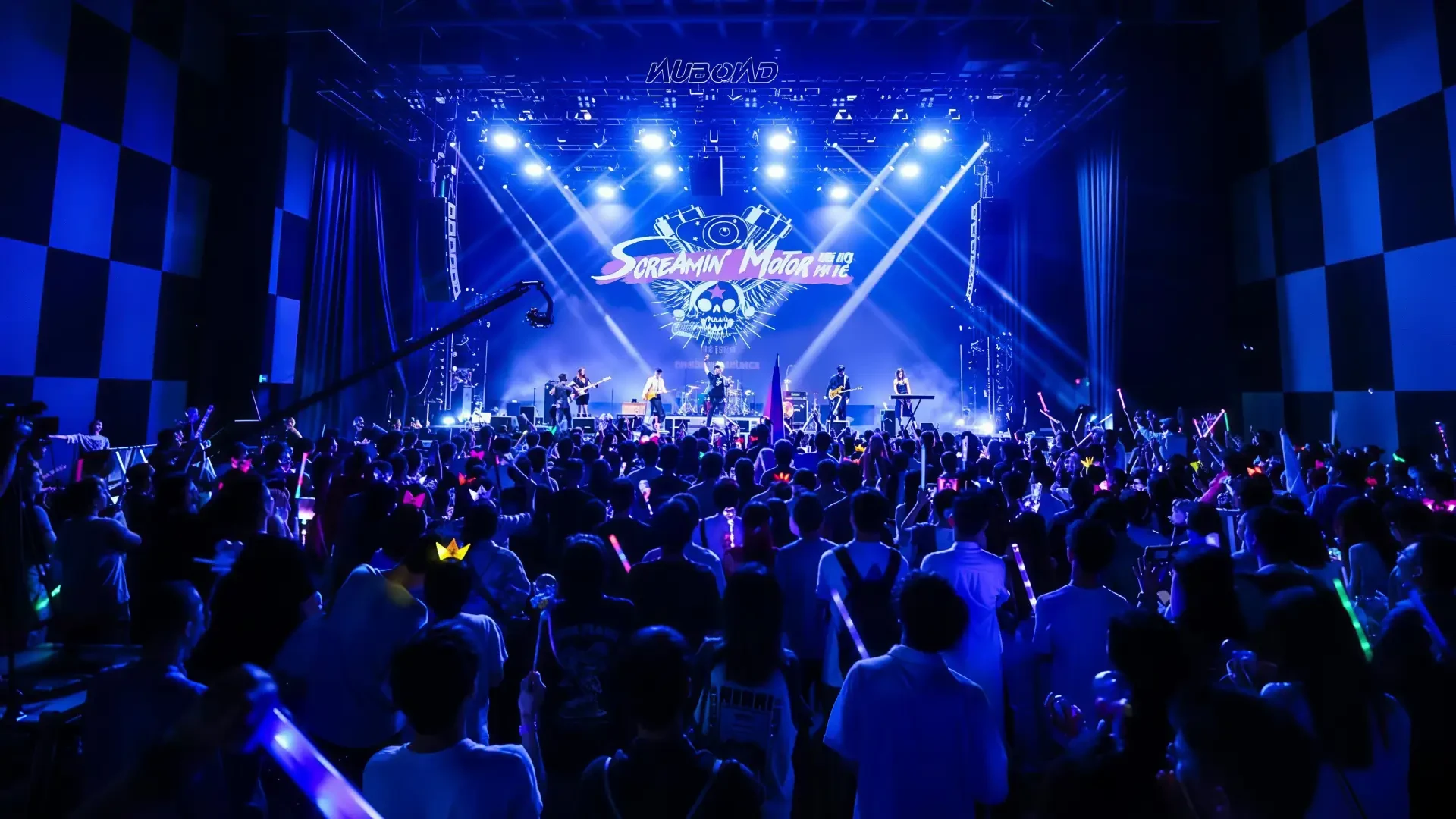
As the industry shifts from traditional tungsten and HMI fixtures to energy-efficient LEDs, the importance of flicker-free LED studio lights has never been higher. Not all LEDs are created equal. In an era where every concert attendee is holding a 4K camera in their pocket, ensuring your music festival stage lighting is camera-safe is no longer optional — it is a critical requirement for your brand's image.
This technical guide explains the science behind LED flicker and provides actionable specifications for choosing the best camera-safe LED stage lights for TV studios and live festivals.
1. The Science of Flicker: Why LEDs Cause Issues on Camera
The AC Power Problem
LEDs do not run on standard Alternating Current (AC) power; they require Direct Current (DC). To convert AC to DC, fixtures use a driver. In cheaper LED lights, the driver does not convert the power smoothly. Instead, it pulses the power to save costs.
The Camera "Shutter Effect"
The human eye is relatively slow and blends light pulses together (persistence of vision). A camera shutter, however, captures a single frame in a fraction of a second. If the camera shutter opens when the LED is in a "dim" pulse, that frame will be dark. This results in vertical banding, rolling bars, or color shifting in your video.
The High-Speed Camera Challenge
The problem multiplies when filming at high frame rates (e.g., 120fps or 240fps for slow-motion replays). At these speeds, the camera exposes the flicker even more severely.
2. The Solution: Broadcast Lighting DMX512 and True Flicker-Free Drivers
High-Frequency Drivers
True flicker-free LED studio lights use high-quality drivers that operate at extremely high frequencies (often >3kHz or higher) or utilize constant-current technology. This eliminates the pulsing effect, making the light perfectly stable regardless of camera shutter speed or frame rate.
Broadcast Lighting DMX512
In a TV studio, lighting changes must be perfectly smooth and precise. Broadcast lighting DMX512 control allows for zero-latency, highly accurate dimming. Unlike consumer Wi-Fi controls, hardwired DMX512 ensures that the light responds instantly to the console, without any digital lag or stuttering.
Smooth Dimming Curves
Cheaper LEDs often "step" when dimmed, dropping from 10% to 5% to 0% abruptly. Professional camera-safe LED stage lights feature 16-bit dimming resolutions, allowing for a silky-smooth fade from 100% down to 0.1% without any visual jumps.
3. Tunable White for TV: Achieving Perfect On-Camera Skin Tones
While flicker is a technical issue, color temperature is an aesthetic one.
The Importance of Tunable White
In a TV studio or broadcast environment, the lighting must match the existing ambient light or set design. Tunable white for TV allows operators to seamlessly adjust the color temperature from 2700K (warm tungsten look) to 6500K (cool daylight) to flatter the presenters' skin tones or match specific scene requirements.
High CRI (Color Rendering Index)
For the most accurate skin tones and vibrant set colors, specify lights with a CRI of 95+ (and TLCI of 95+). Low CRI lights can make actors look sickly or change the color of their clothing on camera.
Green/Magenta Shift
High-end broadcast fixtures often include a green/magenta adjustment to perfectly match other lighting sources on set (like older tungsten lights or specific camera sensors).
4. Music Festival Stage Lighting: Surviving the Live Environment
Smartphone Cameras
You cannot control what cameras are in the audience. To prevent thousands of social media posts featuring banding lines, your festival fixtures must be flicker-free at all common frame rates (24fps, 30fps, 60fps, 120fps).
High Output and Weather Resistance
Festival lights must punch through daylight or compete with large video walls. They must also be IP65 rated to survive sudden rainstorms. Look for high-output moving heads and wash lights that specifically advertise "camera-safe" or "flicker-free" operation.
PWM Frequency Check
Always ask your lighting supplier for the PWM (Pulse Width Modulation) frequency of the fixture. For broadcast and festival use, a PWM frequency of 20kHz or higher is recommended to ensure it is invisible even to high-speed cameras.
FAQ: Flicker-Free LED Lighting for TV & Festivals
Q1: How can I test if an LED light is truly flicker-free?
The easiest way is to use your smartphone camera. Open the camera app and point it at the light. If you see rolling dark bars or rapid flashing on your screen, the light is not suitable for broadcast or video use. For professional verification, use a flicker meter or check the manufacturer's PWM frequency specifications (aim for >20kHz).
Q2: What is the difference between CRI and TLCI, and which matters more for TV?
CRI (Color Rendering Index) is a legacy metric based on human perception. TLCI (Television Lighting Consistency Index) is specifically designed for camera sensors. For tunable white for TV and broadcast lighting, TLCI is the more accurate metric. Look for fixtures with a TLCI of 90 or higher for professional-grade results.
Q3: Can I use standard stage wash lights for a TV broadcast?
Generally, no. Standard stage wash lights often lack the precise dimming curves and color fidelity required for broadcast. They are also likely to flicker on camera. You must specify flicker-free LED studio lights that are explicitly rated for broadcast or film use.
Q4: How does DMX512 control improve video lighting?
Broadcast lighting DMX512 provides reliable, high-speed communication between the lighting console and the fixtures. This allows operators to make precise, instantaneous adjustments to intensity and color temperature, ensuring consistency across multiple cameras and scenes without any digital latency.
Q5: What PWM frequency is recommended for camera-safe LED stage lights?
For broadcast and high-speed camera work, a PWM frequency of 20kHz or higher is recommended. This ensures the flicker is invisible even at high frame rates and slow-motion playback.
Q6: Why do my LED lights flicker on camera but look fine to the eye?
The human eye blends rapid light pulses together (persistence of vision), so flicker above ~60Hz is often invisible. A camera shutter captures a single frame in a fraction of a second, so if it opens during a "dim" pulse, the frame records dark. High-frequency drivers (≥3kHz) or constant-current technology solve this.
Summary
Consideration | Recommendation |
|---|---|
Driver | High-frequency (>3kHz) or constant-current |
PWM Frequency | ≥20kHz for camera-safe operation |
Dimming | 16-bit resolution for smooth fades |
CRI / TLCI | CRI 95+ / TLCI 95+ for broadcast |
Tunable White | 2700K–6500K for TV studios |
Control | DMX512 for zero-latency precision |
Weather Resistance | IP65 for outdoor festivals |
Related Reading
How to Choose a Reliable DMX512 Stage Lighting Supplier for Your Venue →
How to Choose LED Color Temperature for Stage Lighting (2700K–6500K) →
5 Common DMX512 Wiring Mistakes That Cause Stage Lighting Failures →
Need Flicker-Free LED Lighting for Your Studio or Festival?
We supply professional Stage & Theater Lighting solutions — featuring flicker-free LED studio lights, camera-safe LED stage lights for music festivals, and advanced broadcast lighting DMX512 control systems with tunable white for TV.
👉 Contact Us Today for samples, technical support, or a quote.