
Posted July 27, 2026 | Category: Power Solutions | Tags: LED Drivers, Power Supplies, MEAN WELL
Quick Answer
Selecting the right power solution for your LED project depends on three key factors: application environment, electrical requirements, and certification needs. For most commercial and industrial LED projects, MEAN WELL power supplies offer the best balance of reliability, global certifications, and availability — making them the default choice for system integrators. Custom power solutions become necessary when you need specific form factors, unique voltage/current combinations, or special features not available in standard product lines.
Introduction: Why Power Supplies Matter
In any LED lighting system, the power supply is the component most likely to fail — not the LEDs themselves. According to industry data, power supply failures account for over 70% of LED system reliability issues. A high-quality power supply ensures:
Stable light output without flicker
Extended LED lifespan (typically 50,000+ hours)
Protection against voltage surges and environmental factors
Compliance with global safety standards
When you specify a complete LED system, the power supply you choose directly impacts project reliability, maintenance costs, and end-user satisfaction.
The Four Types of LED Power Solutions
1. LED Drivers (Constant Current)
What They Are: Constant current drivers regulate the current flowing through LEDs, ensuring each LED receives the same current regardless of input voltage fluctuations. This is critical for LED chips because they are current-driven devices, not voltage-driven.
Key Specifications:
Output current: Typically 300mA, 600mA, 900mA, 1A, 1.5A
Output voltage: Varies based on LED forward voltage (typically 3V per LED in series)
Dimming support: 0-10V, PWM, DALI, or TRIAC dimming
Advantages:
Extends LED lifespan by preventing current spikes
Maintains consistent brightness across all LEDs
Protects LEDs against thermal runaway
Ideal for applications requiring precise color and brightness control
Best For:
LED strips and modules
Panel lights and downlights
Architectural lighting fixtures
High-power LED arrays
2. Metal Case Power Supplies
What They Are: Robust, enclosed power supplies with metal housings designed for demanding environments. These are typically constant voltage power supplies (12V, 24V, 48V) with high IP ratings for outdoor or industrial use.
Key Specifications:
Output voltage: 12V, 24V, 48V (standard)
Power range: 35W to 600W+
IP rating: IP65, IP67, or IP68 for outdoor use
Operating temperature: -40°C to +70°C
Advantages:
Durable metal housing protects against impact and heat
Weatherproof and dustproof (IP65/IP67)
Excellent heat dissipation for high-power applications
UL, CE, PSE, CCC, and other global certifications
Best For:
Outdoor LED lighting (streetlights, facade lighting, garden lights)
Industrial control cabinets and machinery
LED displays and signage
Security and surveillance systems
Harsh environment installations
3. Desktop Power Adapters
What They Are: External, plug-in power supplies with AC input on one side and DC output on the other. These are constant voltage adapters commonly used to power small to medium LED devices and consumer electronics.
Key Specifications:
Output voltage: 5V, 12V, 24V (common)
Power range: 6W to 150W
Connector: Barrel jack, terminal block, or custom
Efficiency: DOE VI, COC Tier 2 compliant
Advantages:
Compact and lightweight design
Interchangeable — easy to replace without opening equipment
Wide range of global safety certifications (UL, CE, PSE, SAA, KC, CCC)
Cost-effective for low to medium power applications
No special installation required
Best For:
Portable or desktop LED fixtures
Small signage and display lighting
Office and residential lighting
Consumer electronics integration
4. Custom Power Solutions
What They Are: Bespoke power supplies designed and manufactured to meet specific project requirements that off-the-shelf products cannot satisfy.
Customizable Parameters:
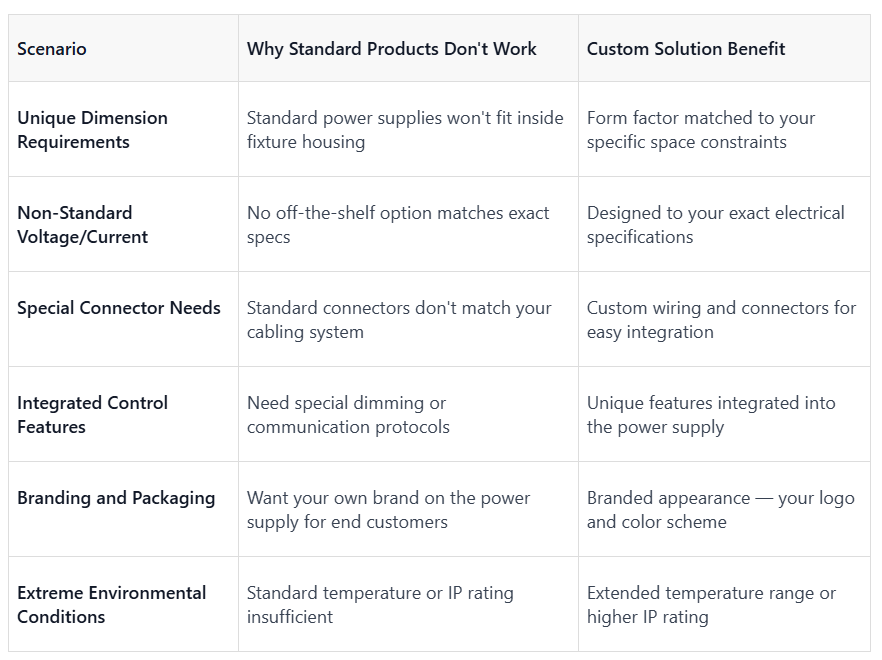
Form factor and dimensions (for space-constrained installations)
Exact voltage/current combinations (non-standard values)
Special connectors and wiring configurations
Custom labeling and branding
Specific environmental ratings (extreme temperatures, high humidity)
Integrated control features
Advantages:
Perfectly matched to the application
Unique form factor saves space in the luminaire design
Enhanced integration with control systems
Brand identity — can be labeled with your brand
Best For:
Unique architectural or artistic lighting projects
OEM applications where space is limited
Projects requiring non-standard electrical specifications
System integration where power supply must fit specific enclosure
MEAN WELL vs. Generic Power Supplies: A Critical Comparison
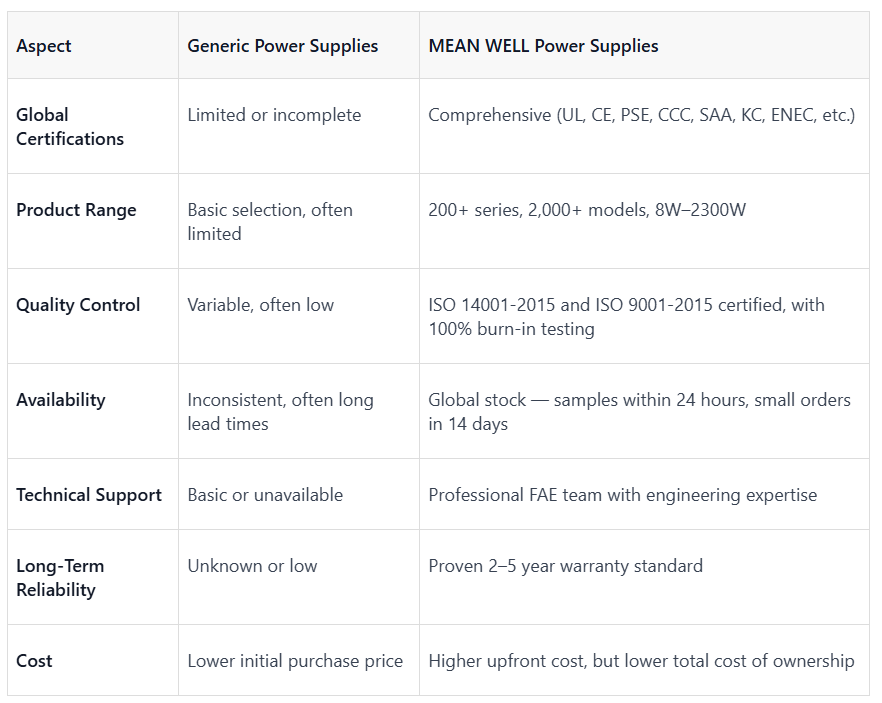
In the LED industry, MEAN WELL is the benchmark for high-quality, standard power supplies. Understanding the difference is essential for B2B buyers making sourcing decisions.
MEAN WELL Profile
Founded in 1982, MEAN WELL is a global top-5 standard power supply manufacturer with an extensive product portfolio covering 8W to 2300W across nearly 200 series and over 2,000 models. They operate globally with offices in China, the USA, Europe, and Asia — with over 300 OEM manufacturing partners and 300+ registered patents, including self-developed in-house IC solutions.
Why Choose MEAN WELL for Your Project?
Global Approvals Save Time and Money: Using MEAN WELL pre-approved power supplies eliminates the need for lengthy and expensive safety certification of the power supply itself, potentially saving 6–12 months and significant costs in regulatory testing.
Reliability Reduces Maintenance Costs: The failure rate of MEAN WELL power supplies is significantly lower than generic alternatives, reducing field failures, warranty claims, and service calls.
Availability Prevents Project Delays: With global stock and fast shipping, MEAN WELL ensures project timelines are met without power supply availability bottlenecks.
Long-term Availability for Maintenance: MEAN WELL maintains long product lifecycles, making it easier to source replacement units for systems that need maintenance years later.
When Custom Power Solutions Make Sense
Even with MEAN WELL's broad portfolio, there are scenarios where standard products cannot meet project requirements. This is where custom power solutions become not just an option but a necessity.
Practical Guide: How to Choose the Right Power Solution
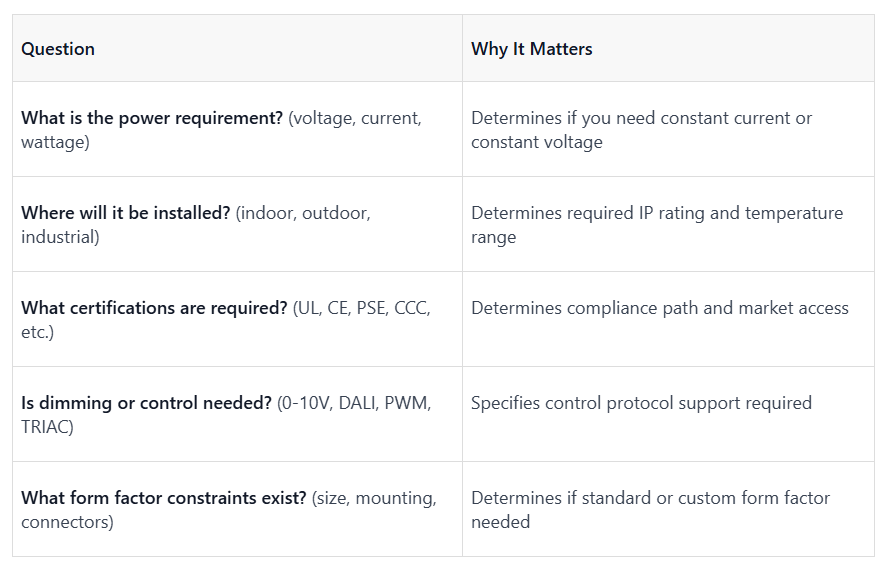
Step 1: Define Your Application Requirements
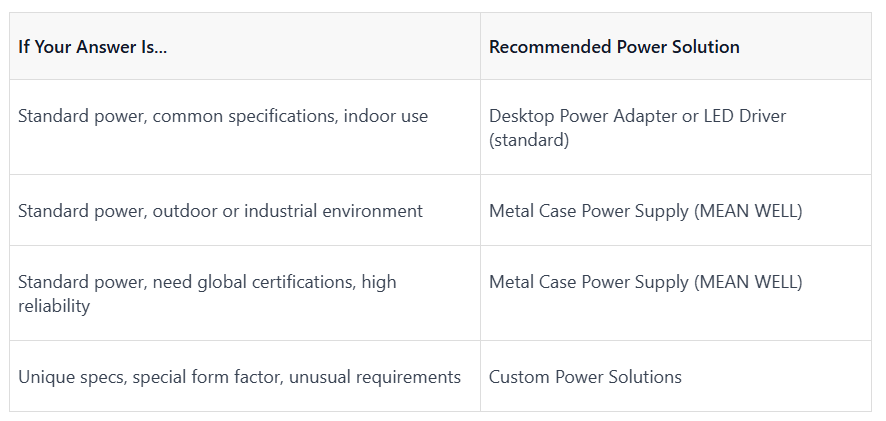
Step 2: Choose Your Path
Technical Specifications to Specify
When documenting your power solution requirements, include the following in your specification:
Power Supply Specification Requirements:
Type: [LED Driver / Metal Case / Desktop Adapter / Custom]
Output Voltage: [Specify V]
Output Current: [Specify A] (for constant current) or [Specify W] (for constant voltage)
Input Voltage Range: [e.g., 100-240V AC / 12-24V DC]
IP Rating: [IP20 / IP65 / IP67 / IP68]
Certifications Required: [UL, CE, PSE, CCC, etc.]
Control Protocol (if dimming): [0-10V / DALI / PWM / TRIAC]
Operating Temperature: [Specify range]
Form Factor: [Dimensions and mounting requirements]
Warranty: [Minimum 3 years preferred]
Conclusion
The power supply is the unsung hero of any LED lighting system. Choosing the right one — whether a standard LED driver, a rugged metal case unit, a compact desktop adapter, or a fully custom solution — directly impacts the reliability, efficiency, and longevity of your lighting project.
For most commercial LED applications, MEAN WELL power supplies offer the optimal balance of reliability, global certifications, and availability, making them a strong default choice. For unique projects, custom power solutions ensure that your specific requirements are met — and can become a valuable differentiator in your service offering.
We work with both MEAN WELL and custom power supply manufacturers to deliver the right power solution for each project. Contact us to discuss your specific requirements.
Related Content
Contact Us
Need help selecting the right power solution for your LED project? Our engineering team can analyze your requirements and recommend the optimal approach — whether a standard MEAN WELL model or a custom design.