
Estimated reading time: 8 minutes
Quick Answer
Pixel point lights are individually addressable LED modules that allow each light point to be controlled independently. They are used in creative signage, artistic sculptures, and themed installations — enabling dynamic animations, color transitions, and precise light control. Key selection factors include pixel pitch (10–50mm+), color options (RGB, RGBW, single-color), voltage (DC5V/12V/24V), IP rating (IP20–IP68), and control protocol (SPI/DMX512).
Introduction: Beyond Building Facades
When we think of pixel point lights, large-scale building facades and city skylines often come to mind. While they are indeed powerful tools for architectural illumination, their true potential extends far beyond that.
Pixel point lights offer unmatched flexibility. They are, in essence, a "brush of light" — allowing designers and creators to paint with individual points of color, bringing any shape or idea to life.
This guide focuses on their technical characteristics and creative applications in custom signage, artistic sculptures, and themed installations.
What Are Pixel Point Lights?
Pixel point lights are individually addressable LED modules — each light point contains one or more LED chips and an integrated control IC, allowing it to be controlled independently from the others.
Unlike standard LED strings where all lights display the same color, pixel point lights can:
Display different colors at each point
Create gradients, chasing effects, and animations
Be mapped to specific coordinates in a display
Core Components
Component | Function |
|---|---|
LED Chip | Emits light (RGB, RGBW, or single-color) |
Control IC | Receives data and controls the LED |
PCB | Mounts the chip and IC, provides electrical connections |
Housing | Protects the assembly (transparent, diffused, or opaque) |
Connector | Links to power and data lines |
Technical Specifications: What to Check
1. Pixel Pitch (Resolution)
Pixel pitch is the distance between the center of one pixel and the next.
Pixel Pitch | Best For | Considerations |
|---|---|---|
Small Pitch (10–20mm) | Close-up viewing, detailed animations, intricate designs | Higher resolution, more pixels per area, higher cost |
Medium Pitch (20–30mm) | General signage, medium-distance viewing | Balanced resolution and cost |
Large Pitch (30–50mm+) | Long-distance viewing, large outlines, budget-conscious projects | Lower resolution, fewer pixels per area, lower cost |
Practical Tip: The optimal pitch depends on the intended viewing distance. A smaller pitch is needed for closer viewing to create a smooth, continuous image.
2. LED Type and Color Options
Option | Benefit | Best For |
|---|---|---|
Full-Color RGB | Millions of colors for vibrant animations | Eye-catching signage, festive displays |
RGBW | RGB plus dedicated white for pure white light | Architectural accents, signage needing white |
Single Color / Warm White | Clean, elegant, subtle look | High-end commercial signage, minimalist art |
3. Voltage and Power
Voltage | Best For | Notes |
|---|---|---|
DC5V | Short runs, small installations | Lower voltage, higher current |
DC12V | Medium runs, general use | Balanced voltage and current |
DC24V | Long runs, large installations | Reduced voltage drop over distance |
4. IP Rating (Environmental Protection)
IP Rating | Protection | Suitable For |
|---|---|---|
IP20 | No water protection | Indoor, dry environments |
IP65 | Dust-tight, water jets | Outdoor, rain-exposed |
IP67 | Temporary immersion | Outdoor, wet conditions |
IP68 | Continuous immersion | Underwater, fountains |
5. Control Protocol
Protocol | Best For | Notes |
|---|---|---|
SPI | Addressable pixel effects | Individual control per pixel |
DMX512 | Professional stage and architectural | Industry standard, 512 channels/universe |
Art-Net / sACN | Large-scale networked systems | Ethernet-based, scalable |
6. Optical Design
Some pixel point lights feature specialized optics (e.g., asymmetric lenses) to direct light precisely and reduce light pollution — important for building facades near residential areas.
Applications: Creative Signage and Artistic Installations
1. Dynamic and Dimensional Signage
Application | Description |
|---|---|
Dynamic Dimensional Letters | Embedded into 3D letterforms, pixel lights create flowing light, color transitions, and animated effects. |
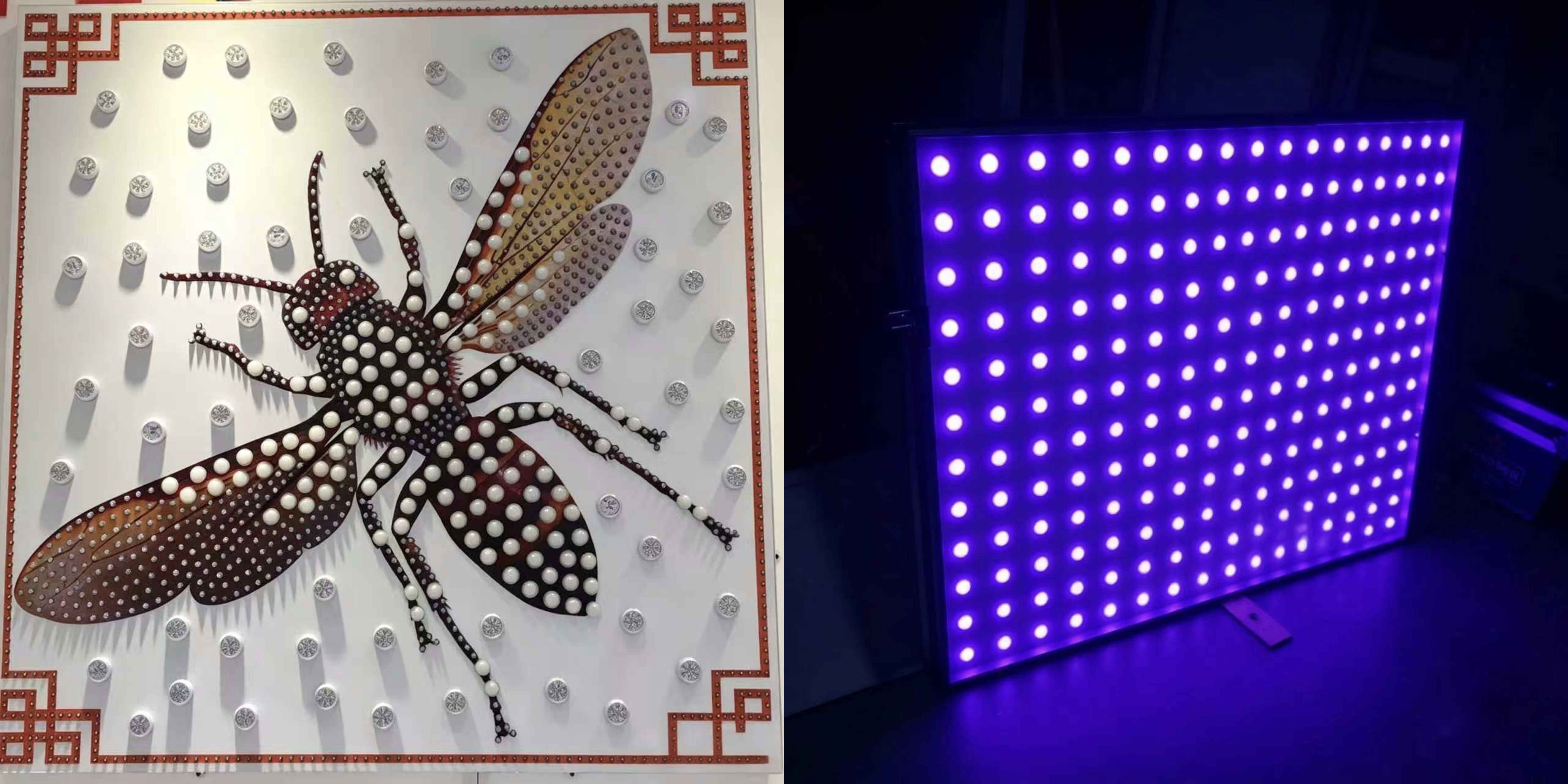
Custom-Shaped Light Panels | Arranged densely, they create display panels in any shape — logos, patterns, or custom graphics. |
2. Artistic Sculptures and Themed Characters
Approach | Description |
|---|---|
Contour Outlining | Tracing the outline of a sculpture (butterfly, bee, dragon) with pixel lights defines the form at night. |
Surface Coverage | A dense grid turns the entire surface into a 3D "pixel screen" for video mapping. |
Modular Matrices | Mounted on flexible grids or cables for large, two-dimensional displays. |
3. Themed Environments
Pixel point lights bring characters and scenes to life in amusement parks, event spaces, and themed attractions.
Installation and Integration
Method | Description | Best For |
|---|---|---|
Grid/Wire Mounting | Pre-assembled on mesh or cable, hung on facades or ceilings | Large-scale signage, curtain displays |
Direct Mounting | Individual lights mounted onto a substrate | Custom letterforms, sculptural surfaces |
Track/Profile Mounting | Installed within a protective channel | Architectural outlines, sleek signage |
Technical Selection Checklist
Check | Question to Answer |
|---|---|
Pixel Pitch | What is the viewing distance? Smaller pitch for closer viewing. |
Color | RGB, RGBW, or single-color? |
Voltage | DC5V, DC12V, or DC24V? Match to run length. |
IP Rating | Indoor or outdoor? IP20, IP65, IP67, or IP68? |
Control | SPI or DMX512? Match to existing control system. |
Optics | Standard or asymmetric? Light control requirements? |
Installation | Grid, direct, or track mounting? |
Related Content
👉 Custom 50mm Pixel Globe Light for Letter Signage – A Unique Project Story →
Summary
Consideration | Recommendation |
|---|---|
Pixel Pitch | 10–20mm (close), 30–50mm+ (distant) |
Color | RGB, RGBW, or single-color |
Voltage | DC5V (short), DC12V (medium), DC24V (long) |
IP Rating | IP20 (indoor), IP65–IP68 (outdoor) |
Control | SPI (pixel effects), DMX512 (professional) |
Optics | Standard or asymmetric |
Installation | Grid, direct, or track |
Need Help Selecting Pixel Point Lights?
We supply pixel point lights for creative signage, artistic installations, and themed environments — with options for pixel pitch, color, voltage, and control protocol. Our team can help you select the right configuration for your project.
👉 Contact Us Today to discuss your custom lighting requirements.