
Estimated reading time: 9 minutes
How to Choose the Right RGBWW Mixing Architecture for Permanent Outdoor Lighting
Estimated reading time: 9 minutes
Quick Answer
For permanent outdoor lighting, the choice between RGBWW, RGB+CCT, and addressable RGBWW architectures determines white quality, animation capability, and system complexity. RGBWW (4-channel) solves the white quality problem at moderate cost — ideal for eave lights and accent fixtures with fixed white requirements. RGB+CCT (5-channel) adds tunable white for applications where white temperature flexibility matters, such as wall lights. Addressable RGBWW (SPI) combines per-pixel effects with dedicated white — best for premium eave and bulb string products competing on dynamic capability. Match the architecture to the application, not the other way around.
Introduction: The Problem with "Good Enough" White Light
When permanent outdoor lighting first emerged around 2020, most products relied on basic RGB LEDs. The pitch was simple: install once, run year-round, switch between white architectural lighting and colorful holiday effects.
The reality was less elegant.
RGB-only systems generate "white" light by mixing red, green, and blue channels simultaneously. The result is rarely pure. Depending on the specific LED binning and calibration, RGB-white tends toward blue-tinted coolness or, worse, a faint rainbow shimmer that is visible on light-colored surfaces.
For a product marketed as a permanent outdoor fixture — something that runs 300+ days a year in plain white mode — this was a significant quality gap.
The industry's response has been the gradual adoption of multi-channel architectures that separate white light generation from color generation. Today, the choice between RGBWW, RGB+CCT, and addressable RGBWW (SPI-based) architectures is one of the most consequential decisions for permanent outdoor lighting products.
This guide breaks down the trade-offs and provides selection guidance by application type.
Architecture Comparison: RGBWW vs. RGB+CCT vs. Addressable RGBWW
RGBWW (4-Channel: R/G/B + Single White)
RGBWW adds a dedicated white LED to the standard RGB package. This single addition addresses the core weakness of RGB: white light is no longer synthesized from color channels. The dedicated white LED produces cleaner, brighter white light with no color mixing artifacts.
The white channel is typically fixed at a single color temperature — most commonly 4000K neutral or 2700K warm. There is no tunability between warm and cool white; the white is whatever the LED chip provides.
Specification | Detail |
|---|---|
Channel count | 4 (R, G, B, W) |
Controller requirement | Standard 4-channel PWM controller or DMX decoder |
White quality | Clean, dedicated white |
White flexibility | Fixed temperature only |
Key trade-off: RGBWW solves the white quality problem but limits white flexibility. You get good white and good color, but not tunable white.
RGB+CCT (5-Channel: R/G/B + Warm White + Cool White)
RGB+CCT takes the RGBWW concept further by replacing the single white channel with two: warm white (typically 2700K–3000K) and cool white (typically 6000K–6500K).
By adjusting the relative intensity of the two white channels, the system can produce any color temperature between the warm and cool endpoints. This is "tunable white" in the true sense — not just good white, but adjustable white.
For permanent outdoor lighting, this matters because white light requirements change by time of day, season, and use context. Warm white (2700K–3000K) is appropriate for evening residential ambiance. Cool white (4000K–5000K) is better for task lighting, security illumination, or commercial exteriors.
Specification | Detail |
|---|---|
Channel count | 5 (R, G, B, WW, CW) |
Controller requirement | 5-channel PWM controller or DMX decoder |
White quality | Clean, dedicated white |
White flexibility | Fully tunable (2700K–6500K) |
Key trade-off: RGB+CCT offers the highest white flexibility but requires more channels, a more sophisticated controller, and careful thermal management.
Addressable RGBWW (SPI-Based, Per-Pixel Control)
Addressable RGBWW combines the white-quality benefits of RGBWW with the per-pixel control of SPI (Serial Peripheral Interface) architectures.
In an addressable RGBWW system, each pixel point contains its own control IC (such as SK6812 RGBW) and four channels: R, G, B, and a dedicated white LED. The white channel is typically fixed-temperature (4000K neutral is common), though warm-white variants exist.
Specification | Detail |
|---|---|
Channel count | 4 per pixel (R, G, B, W) |
Controller requirement | SPI-compatible controller (WLED, modern pixel controllers) |
White quality | Clean, dedicated white |
Animation | Per-pixel effects |
Key trade-off: Highest per-pixel cost, more complex wiring, and stricter power/signal integrity requirements over long runs.
Application-by-Application Selection Guide
The "best" architecture depends entirely on the application. Here is how the three options map to the most common permanent outdoor lighting applications.
Eave Lights (Under-Soffit Permanent Strips)
Recommended: RGBWW (fixed white) or Addressable RGBWW (SPI)
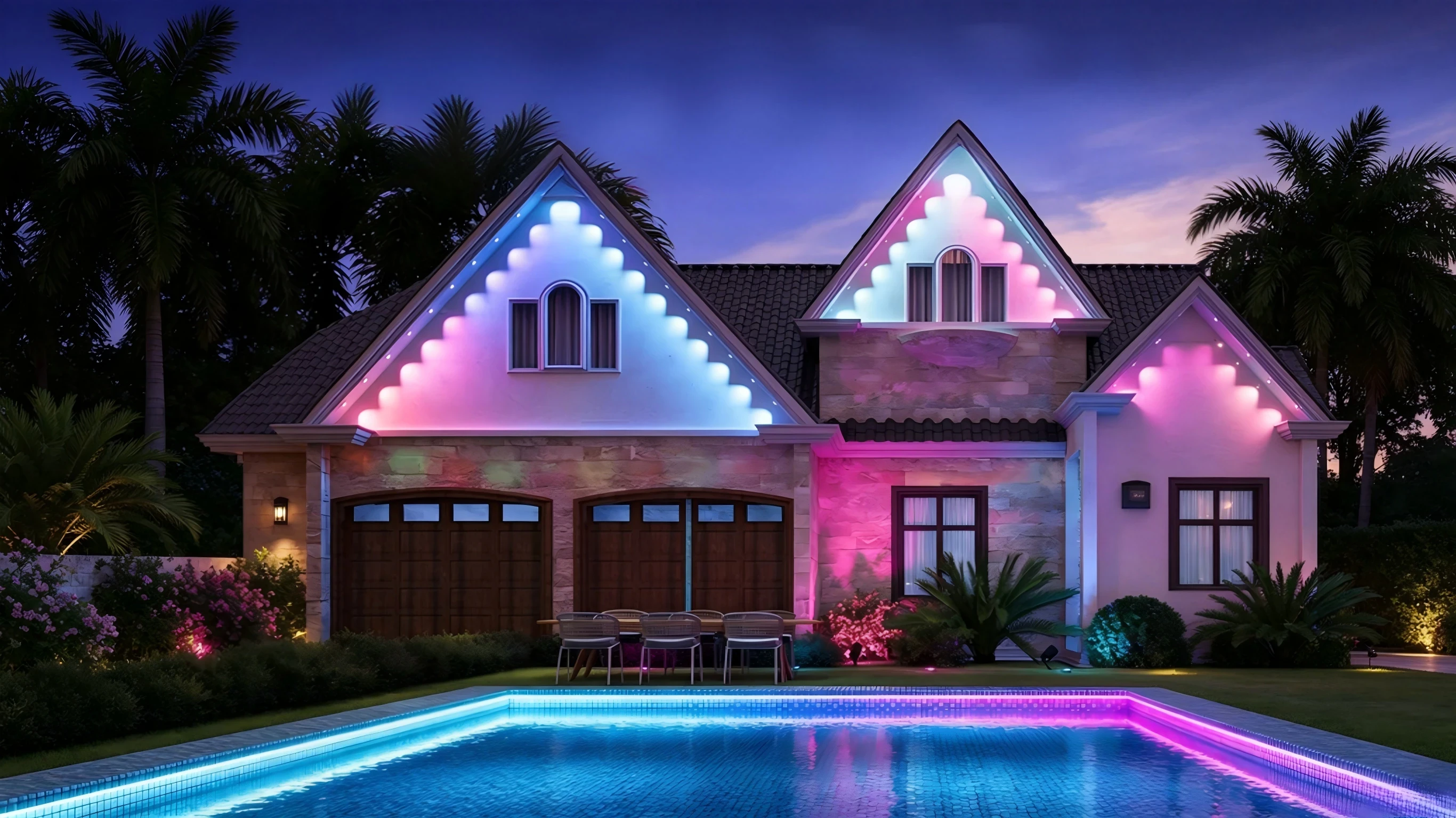
Eave lighting is the flagship application for permanent outdoor lighting. The product runs daily as architectural illumination and occasionally as holiday lighting. White light quality is the primary product differentiator for most of the year.
For eave lights where per-pixel effects are not required, RGBWW with fixed neutral white (4000K) offers the optimal balance: clean white, good color, moderate cost, and simpler controller integration.
For premium eave light products competing on animation capability, addressable RGBWW (SPI) is the right choice. The ability to run individual-pixel effects while maintaining dedicated white LEDs justifies the additional cost and complexity.
What to avoid: RGB-only architectures. The blue-tinted "white" is a visible quality defect on residential fascia and soffit surfaces, especially on light-colored homes.
Wall Lights (Zone-Controlled Exterior Sconces)
Recommended: RGB+CCT (for tunable white) or RGBWW with zone control
Wall lights serve both decorative and functional roles. In residential settings, they may need warm white in the evening and cooler white for security. In commercial or hospitality settings, tunable white is often a specification requirement.
RGB+CCT is the natural fit for wall lights where white temperature flexibility is valued. The 5-channel architecture supports independent zone control while providing full white tunability.
For wall lights with a more static white requirement, RGBWW with fixed white is a simpler, lower-cost option.
Bulb String Lights (Decorative Outdoor String Lighting)
Recommended: Addressable RGBWW (SPI) for premium; RGBWW for standard
Bulb string lights are the fastest-evolving permanent outdoor form factor. Leading products now offer per-bulb color control, where each bulb is an independently addressable pixel.
For a premium bulb string product, addressable RGBWW is the clear architecture. It enables per-bulb color effects for holidays while maintaining clean white light for everyday use — a combination that RGB-only addressable strings cannot match.
For a standard bulb string targeting cost-sensitive markets, RGBWW with string-level (not bulb-level) control is a reasonable compromise. White quality is preserved; the sacrifice is per-bulb animation granularity.
Pathway Lights, Deck Lights, and Accent Fixtures
Recommended: RGBWW (fixed white) with PWM control
These auxiliary fixtures serve accent and wayfinding roles. Per-pixel control is rarely necessary. RGBWW with fixed white provides adequate color capability and clean white light at lower cost and complexity than RGB+CCT or addressable solutions.
Control Architecture: Matching the Controller to the Mixing Scheme
The mixing architecture choice determines the controller requirements. This is not an afterthought — it is a constraint that should be evaluated during product definition.
Architecture | Control Method | Compatible Controllers | Signal Distance Limitation |
|---|---|---|---|
RGBWW | PWM (4-channel) | 4-channel RF, DMX, 0–10V, DALI | Long runs possible with power injection |
RGB+CCT | PWM (5-channel) | 5-channel DMX, specialized CCT controllers | Similar to RGBWW; more channels = more wiring |
Addressable RGBWW | SPI | WLED, SK6812-compatible pixel controllers | Signal degradation beyond ~5m without amplifier |
Key consideration for SPI/addressable systems: The digital data signal degrades over distance. For permanent outdoor installations with long runs, signal amplifiers or repeaters are typically required every 5 meters. This is a wiring and installation complexity that must be planned for at the system design stage.
For PWM-based architectures (RGBWW and RGB+CCT), the primary constraint is voltage drop on power lines, not signal integrity. Parallel power injection at regular intervals handles this on long runs.
The White Quality Difference: What the Data Shows
The practical difference between these architectures is most visible in white light performance.
Products using dedicated white LEDs (RGBWW or RGB+CCT) consistently achieve higher white output and better white quality than RGB-only systems. For example, in the permanent outdoor lighting category, systems with dedicated warm/cool white LEDs produce white light in the 1500K–9000K range with brightness levels approximately 30–50% higher than RGB-mixed white.
The white quality difference is not subjective. RGB-mixed white often exhibits:
Issue | Impact |
|---|---|
Color temperature drift | At different dimming levels |
Visible color fringing | On adjacent surfaces |
Inconsistent white | Between pixels in addressable RGB-only systems |
For a product marketed as "permanent" and "architectural," these are quality defects that dedicated-white architectures eliminate.
Making the Choice: A Decision Framework
Use this sequence to narrow the selection:
Step 1: Define the White Light Requirement
Requirement | Recommended Architecture |
|---|---|
Single fixed white temperature acceptable | RGBWW |
Tunable white temperature required | RGB+CCT |
Clean white essential, tunable not required | RGBWW or Addressable RGBWW |
Step 2: Define the Animation/Effect Requirement
Requirement | Recommended Architecture |
|---|---|
String-level or zone-level effects sufficient | PWM-based (RGBWW or RGB+CCT) |
Per-pixel or per-bulb effects required | Addressable RGBWW (SPI) |
Step 3: Evaluate Control System Compatibility
Consideration | Action |
|---|---|
Existing ecosystem (Matter, Alexa, etc.) | Check controller support |
Long runs (>5m for SPI) | Plan for signal amplification |
Step 4: Validate Thermal and Power Budget
Consideration | Impact |
|---|---|
RGB+CCT adds a fifth channel | More current per meter |
Addressable RGBWW adds IC chips | More heat density per pixel |
Confirm driver capacity | Before committing |
Related Reading
For a deeper look at how pixel lighting performs in demanding applications — including power injection limits, camera compatibility, and IP rating scope — see our guide:
IP65 vs IP67 vs IP68: What Outdoor Facade Lighting Really Needs →
Summary
Architecture | Best For | White Quality | Animation | Complexity |
|---|---|---|---|---|
RGBWW (4-channel) | Eave lights, accent fixtures | Clean, fixed | Zone-level | Moderate |
RGB+CCT (5-channel) | Wall lights, premium fixtures | Clean, tunable | Zone-level | Higher |
Addressable RGBWW (SPI) | Premium eave lights, bulb strings | Clean, fixed | Per-pixel | Highest |
The right choice depends on the specific permanent outdoor lighting product and its target market. For teams developing these products, matching the architecture to the application — from prototype validation through mass production — is the key to success.
Looking for Permanent Outdoor LED Lighting Solutions?
We provide custom LED solutions for permanent outdoor lighting — including RGBWW, RGB+CCT, and addressable RGBWW architectures. Tell us your project requirements, and we will recommend the right configuration.
👉 Contact Us Today to discuss your permanent outdoor lighting project.