
When designing addressable LED strip projects, one of the most critical decisions is selecting the right LED chip. Two popular options from the SK68xx series are the SK6809 (RGB) and the SK6816 (RGBW) .
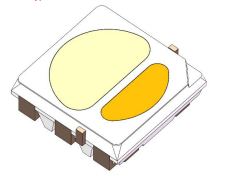
While they share many similarities, their differences can significantly impact your project's performance, color quality, and application suitability.
This article breaks down the key technical differences to help you make an informed choice.
Quick Overview
Feature | SK6809 | SK6816 |
|---|---|---|
Color Type | RGB (Red, Green, Blue) | RGBW (Red, Green, Blue, White) |
Output Current (Default) | 9mA per channel | 15.5mA per channel |
Recommended Current | 5mA (RGB) | 3mA (RGB) / 5mA (White) |
Data Protocol | Single-wire zero code (800Kbps) | Single-wire zero code (800Kbps) |
Grayscale | 256 levels per channel | 256 levels per channel |
Data Structure | 24-bit (GRB order) | 32-bit (GRBW order) |
Voltage | DC24V | DC24V |
Package Size | 5.2 × 4.9 × 1.4mm | 5.2 × 4.9 × 1.4mm |
Viewing Angle | 120° | 120° |
Key Difference 1: RGB vs RGBW
The most fundamental difference is that SK6809 is RGB (three color channels), while SK6816 is RGBW (four channels including a dedicated white).
Aspect | SK6809 (RGB) | SK6816 (RGBW) |
|---|---|---|
White light generation | Mixes RGB to create white | Dedicated white LED chip |
White color purity | Can look slightly tinted or uneven | Pure, clean white light |
Color rendering | Good for general color effects | Excellent, especially for white tones |
Power efficiency for white | Lower (uses 3 channels) | Higher (single white channel) |
When to choose SK6816: Projects requiring high-quality white light — such as architectural cove lighting, retail displays, or hospitality venues where both color effects and pure white are needed.
When to choose SK6809: Pure color-changing applications where white light is rarely used — such as accent lighting, entertainment venues, or decorative displays.
Key Difference 2: Output Current and Power Consumption
Parameter | SK6809 | SK6816 |
|---|---|---|
Default output current | 9mA per channel | 15.5mA per channel |
Recommended current | 5mA (RGB) | 3mA (RGB) / 5mA (White) |
Typical application | Standard brightness | Higher brightness with dedicated white |
Important note: While SK6816 has a higher default current, the manufacturer recommends using lower currents in practice (3mA for RGB, 5mA for white) to optimize performance and longevity.
For a white-only scene, SK6816 consumes only 5mA (single channel), whereas SK6809 would need all three RGB channels active — consuming approximately 15mA — to produce a white appearance. SK6816 is significantly more power-efficient for white light production.
Key Difference 3: Data Structure and Cascade Capability
Both chips use a single-wire zero-code protocol at 800Kbps, but the data frame length differs:
Chip | Data Structure | Bits per Pixel | Cascade Limit (30fps) |
|---|---|---|---|
SK6809 | GRB (Green-Red-Blue) | 24-bit | < 1024 pixels |
SK6816 | GRBW (Green-Red-Blue-White) | 32-bit | < 1024 pixels |
The longer data frame of SK6816 (32-bit vs 24-bit) means that for the same number of pixels, SK6816 requires slightly more data transmission. However, both support cascading over 1000 pixels at 30 frames per second — sufficient for most medium to large installations.
Application Scenarios Comparison
Application | Recommended Chip | Reason |
|---|---|---|
Bar / KTV accent lighting | SK6809 | Color-changing effects are primary; white light rarely needed |
Retail display lighting | SK6816 | Needs pure white light to illuminate products accurately |
Architectural cove lighting | SK6816 | Often requires both color effects and quality white light |
Stage backdrops | SK6809 | Dynamic color effects are the focus |
Hotel lobby lighting | SK6816 | Demands high-quality white light for general ambiance |
Festival / event decorations | SK6809 | Cost-effective for temporary color displays |
Electrical Parameters Comparison
Parameter | SK6809 | SK6816 |
|---|---|---|
Operating voltage | DC20-24V | DC20-24V |
PWM frequency | 1KHz | 4KHz |
Static power consumption | ~0.2mA | ~3mA |
ESD protection | 2KV | 2KV |
Operating temperature | -40°C to +80°C | -40°C to +80°C |
The higher PWM frequency of SK6816 (4KHz vs 1KHz) can reduce visible flicker in video recordings or high-speed camera applications — an important consideration for stage or broadcast environments.
Wiring and Circuit Design Considerations
Both chips require similar circuit design:
Decoupling capacitor between each chip (recommended for stable operation)
Protective resistors (approximately 500Ω) at signal input and output to prevent ESD damage
Single data line with daisy-chain connection
Example typical application circuit (same for both):
MCU → [Resistor] → DIN of first LED → DOUT → next LED ... → GND
Summary: Which One Should You Choose?
If your project requires... | Choose |
|---|---|
Pure, high-quality white light + color effects | SK6816 (RGBW) |
Only color-changing effects (no white needed) | SK6809 (RGB) |
Higher white light power efficiency | SK6816 |
Lower cost per pixel | SK6809 |
Reduced flicker for video recording | SK6816 (4KHz PWM) |
Final Thoughts
Both SK6809 and SK6816 are excellent, mature chips widely used in the addressable LED industry. Your choice should be driven by whether your application needs a dedicated white channel.
For pure color effects → SK6809 is cost-effective and sufficient.
For mixed color + quality white → SK6816 is the right choice.
At ElisaCustom, we offer both RGB and RGBW addressable LED strips using these chips. Contact us to discuss your project requirements — we can help you select the optimal solution.
👉 Contact Us Today for samples or technical support.