
Posted August 1, 2026 | Category: Technical Guide | Tags: Power Solutions, LED Drivers, System Design
Quick Answer
Calculating the right power supply wattage follows a simple formula: Multiply the total wattage of your LED load by 1.25 (to add a 20% safety margin), then round up to the next available power supply size. For example, if your LED load is 65W, you need at least 65W × 1.25 = 81.25W, so you would choose a 100W power supply .
Why this matters: A properly sized power supply prevents flickering, overheating, and premature failure . Undersizing causes shutdowns and strobing; oversizing wastes money and may cause inefficiency. The 20% safety margin ensures your power supply runs cooler and lasts longer, while accommodating voltage variations and future expansion .
Step 1: Understand the Difference Between Drivers and Power Supplies
Before calculating wattage, it helps to know what you're sizing.
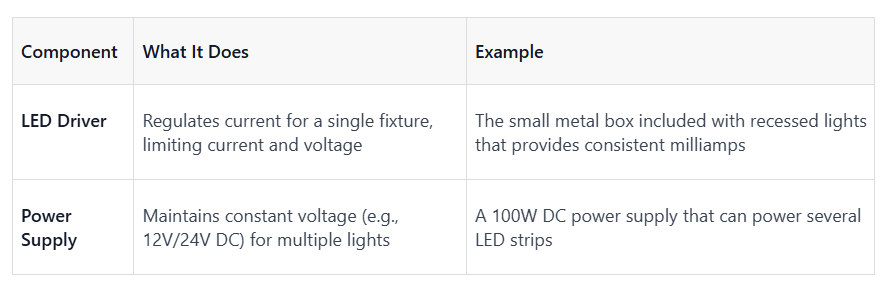
Most LED strip projects use a power supply, because you typically connect multiple strips or modules that need constant voltage. If you're powering a single high-power fixture, you may need a driver that regulates current.
Key safety consideration: For residential, outdoor, or wet locations, you may need a Class 2 power supply. NEC limits Class 2 to 60V DC, 4A, and 100W (typically 48W at 12V or 96W at 24V), reducing shock and fire risk .
Step 2: Gather Your Project Information
You need three pieces of information:
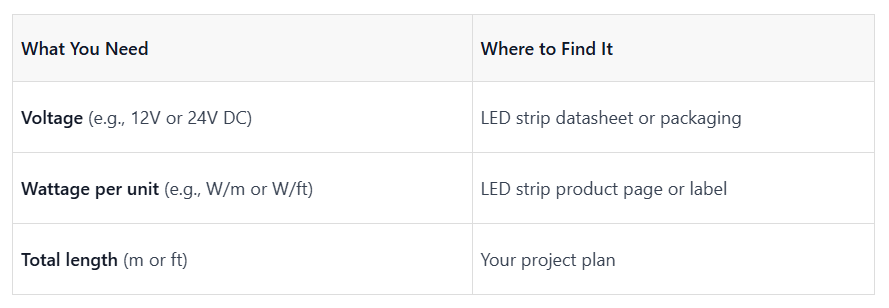
Important: Some products list amperage (A) instead of wattage. If so, use this formula:
Watts = Volts × Amps
For example, a 5V strip drawing 3.6A consumes 5V × 3.6A = 18W .
Step 3: Calculate Total Load Wattage
Formula:
Total Load (W) = Length × Wattage per Unit
Example (from Super Bright LEDs) :
Project: 22 feet of under-cabinet lighting
Strip consumption: 3.5W per foot
Total load: 22 ft × 3.5 W/ft = 77W
For addressable LEDs (WS2812B, etc.): Use the rule of thumb — 60mA per LED at full white brightness (all three color channels at 255) .
Examples :
30 LEDs: 30 × 60mA = 1.8A → recommend 2.5A supply
60 LEDs: 60 × 60mA = 3.6A → recommend 5A supply
100 LEDs: 100 × 60mA = 6.0A → recommend 8A supply
For these, calculate Watts = Volts × Amps. A 5V strip with 100 LEDs draws 6A, so 5V × 6A = 30W.
Step 4: Apply the 20% Safety Margin
Why 20%? Operating a power supply at 100% capacity causes it to run hot, reducing its lifespan and potentially causing failure. The 20% margin keeps it running cooler and provides room for:
Voltage fluctuations
Future expansion
Manufacturing tolerances in LEDs
Formula:
Minimum Power Supply Rating = Total Load × 1.25
Or equivalently:
Minimum Power Supply Rating = Total Load ÷ 0.80
Example (using the 77W load from Step 3):
77W × 1.25 = 96.25W
77W ÷ 0.80 = 96.25W
You need a power supply rated for at least 96.25W
Step 5: Round Up to the Next Available Size
Power supplies come in standard wattages: 60W, 100W, 150W, 200W, 350W, etc.
Rule: Always round up to the next available size.
96.25W → choose 100W power supply
65W × 1.25 = 81.25W → choose 100W power supply
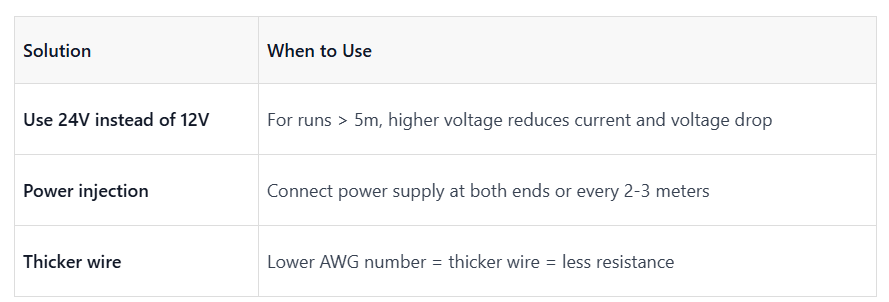
Step 6: Consider Voltage Drop for Large Installations
For runs over 5 meters (16 feet), voltage drop becomes significant. This is particularly critical for 5V LED strips, where the allowable voltage drop is only 0.25V (5% of 5V) .
Step 7: Select IP Rating Based on Environment
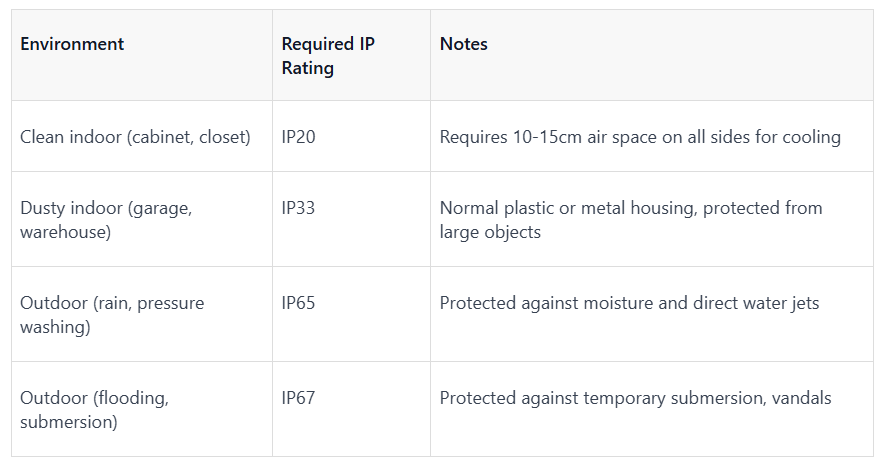
Note: Power supplies are typically rated for -40°F to +122°F (-40°C to +50°C). Allow approximately 3 inches of clearance on all sides for proper airflow per NEC guidelines .
Step 8: Choose Between Dimmable and Non-Dimmable
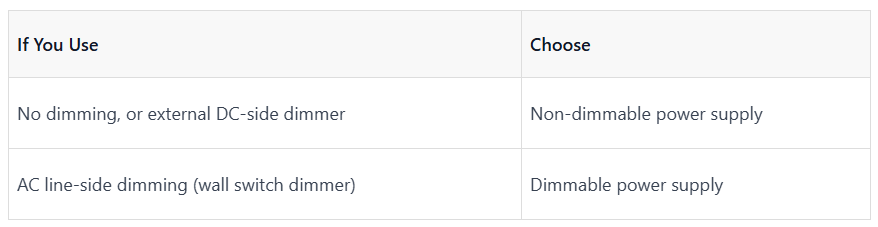
Some dimmable power supplies have a minimum load requirement. For example, a 200W dimmable supply may need at least 10W connected; otherwise, the lights may flicker or behave erratically .
Real-World Examples
Example 1: Under-Cabinet Lighting
Strip: 24V, 4.8W/m, 5 meters
Total load: 5 × 4.8 = 24W
20% margin: 24W × 1.25 = 30W
Round up → Choose: 60W power supply
Example 2: Stage RGB Strip
Strip: 5V addressable, 60 LEDs/m, 5 meters → 300 LEDs
Current draw (max): 300 × 60mA = 18A
Power: 5V × 18A = 90W
20% margin: 90W × 1.25 = 112.5W
Round up → Choose: 150W power supply
Example 3: LED String Light Project
1000 LEDs, 5V addressable, full white
Total current: 1000 × 60mA = 60A
Power: 5V × 60A = 300W
20% margin: 300W × 1.25 = 375W
Round up → Choose: 400W power supply
Note: For this scale, consider power injection every 2-3 meters .
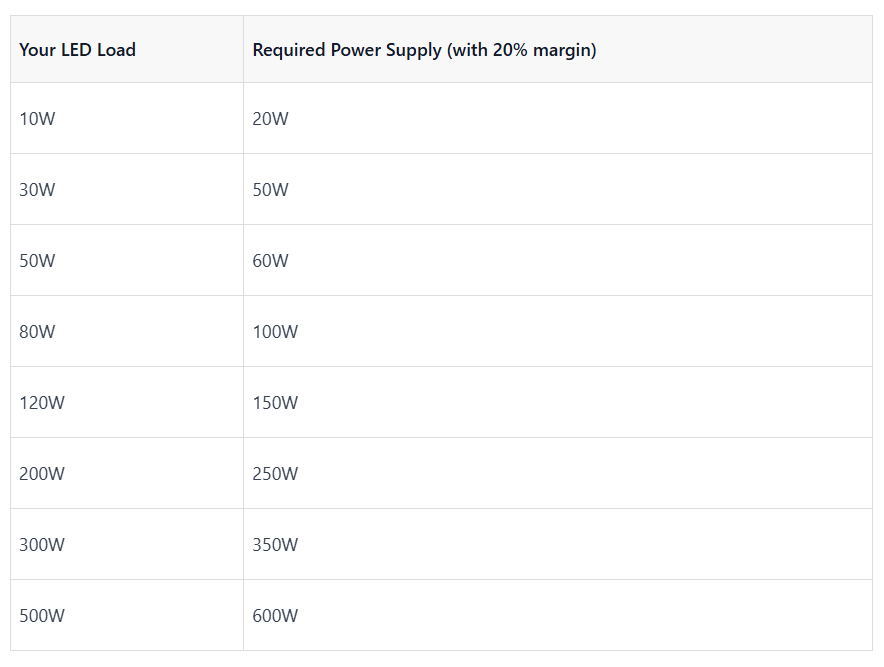
Power Calculator Quick Reference
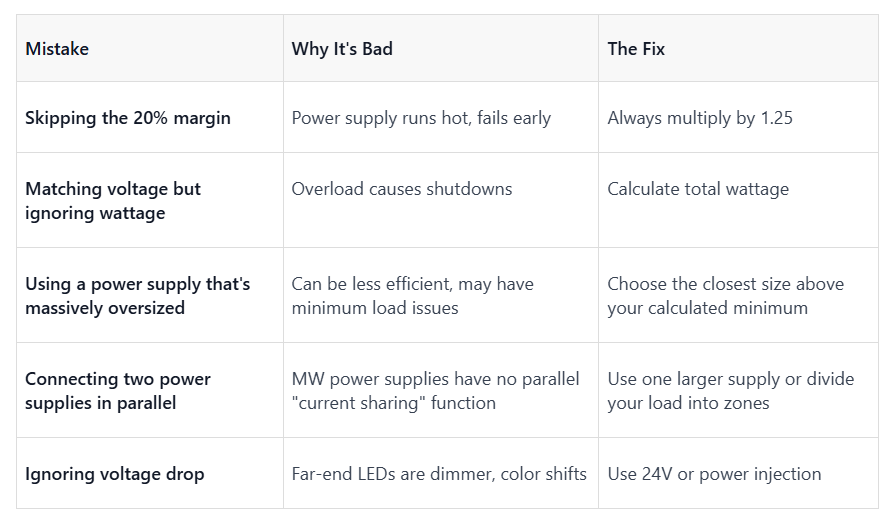
Common Mistakes to Avoid
Specification Template
When ordering or specifying a power supply for your project:
LED Power Supply Specification
Output Voltage: [12V / 24V / 48V / other]
Output Power: [Calculated minimum + 20%]
AC Input: [100-240V AC universal / 120V AC / 277V AC]
IP Rating: [IP20 indoor / IP65 outdoor / IP67 waterproof]
Dimming: [Non-dimmable / 0-10V dimmable / TRIAC dimmable]
Class: [Class 2 / Class 1]
Certifications: [UL, CE, PSE, CCC, etc.]
Operating Temperature: [Specify range based on environment]
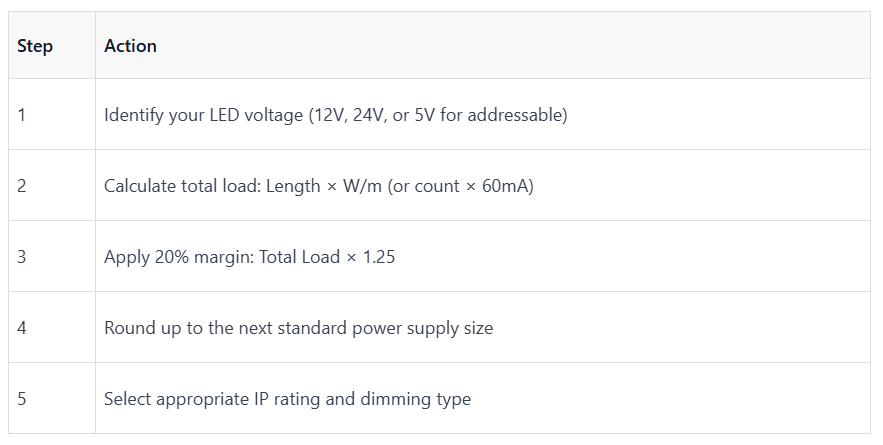
Summary
Related Content
Contact Us
Need help calculating the right power supply for your specific LED project? Our engineering team can analyze your load requirements and recommend the optimal power solution.