
Posted August 1, 2026 | Category: Technical Guide | Tags: Power Solutions, LED Drivers, System Design
Quick Answer
The short answer: all LED drivers are power supplies, but not all power supplies are LED drivers . A power supply is a general-purpose device that converts AC to DC voltage for various electronics (computers, phones, etc.). An LED driver is a specialized power supply designed specifically for LEDs — it regulates both voltage and current to provide stable, flicker-free operation .
Why this matters: LEDs are current-driven devices, not voltage-driven. A tiny 3% change in voltage can cause a 50% increase in current, potentially destroying the LED . The right driver protects your LEDs, extends their lifespan, and ensures consistent brightness. Using a general power supply without current regulation risks overheating, flickering, and premature failure.
The Core Difference
The fundamental distinction comes down to what they regulate:
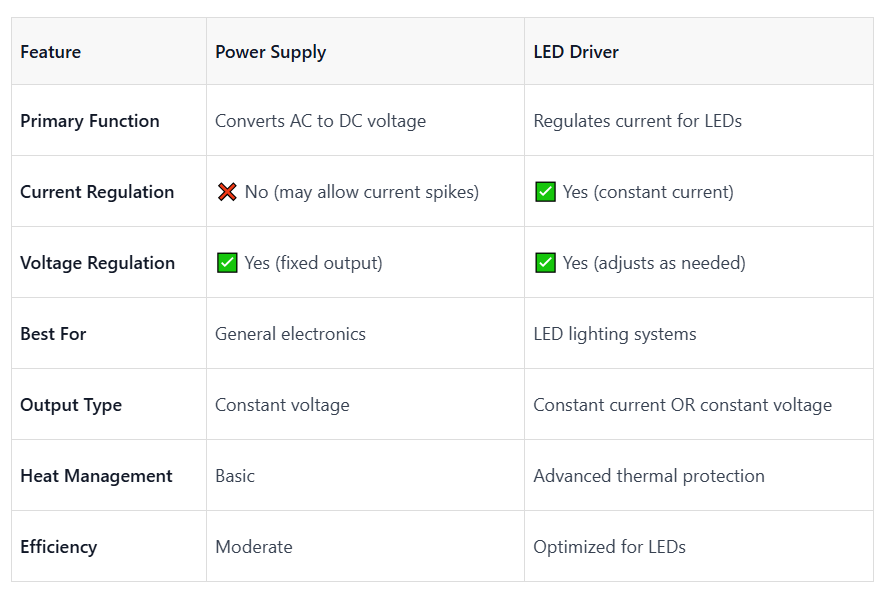
Think of it this way: a power supply is like a water main that provides pressure (voltage). An LED driver is like a precision valve that controls the exact flow (current) to each fixture . If you connect an LED directly to a standard power supply without current regulation, it will draw as much current as it can—overheating and failing quickly.
What Is a Power Supply?
A power supply is a broad category of device that converts alternating current (AC) from the wall outlet into direct current (DC) needed by most electronics . Standard wall outlets provide AC power at 120V (US) or 220V (EU). Most LED lights require DC power at much lower voltages—typically 12V or 24V.
Common applications:
Laptops and computers
Phone chargers
Routers and printers
General electronics
Key limitation: Power supplies maintain a constant voltage (e.g., 12V DC), but they do not regulate current. If you connect an LED to a standard power supply, the LED will draw as much current as it needs—which is often too much, causing overheating and damage .
What Is an LED Driver?
An LED driver is a specialized power supply designed specifically for LEDs . It provides not just voltage conversion but also current regulation—ensuring the LED receives a constant, safe current regardless of voltage fluctuations .
Why LEDs need drivers:
LEDs are current-driven devices (not voltage-driven)
A 3% voltage change can cause a 50% current increase
Without current regulation, LEDs overheat and fail prematurely
Drivers ensure stable brightness, color consistency, and long lifespan
Where drivers are used:
Recessed lights (drivers are often built into the fixture junction box)
Panel lights
Downlights and spotlights
High-power LED arrays
Constant Current vs. Constant Voltage Drivers
LED drivers come in two main types, each suited for different applications:
Constant Current (CC) Drivers
Constant current drivers provide a fixed output current (measured in mA or A) while allowing voltage to vary based on the LED load .
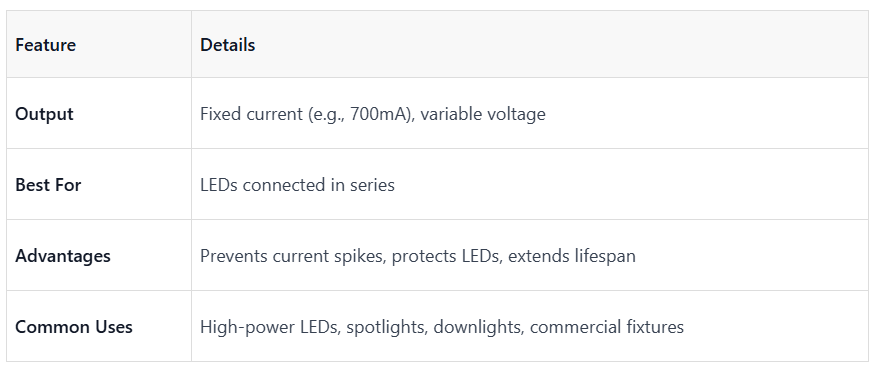
How they work: The driver adjusts its output voltage to maintain a constant current as the LED's forward voltage changes with temperature . This is critical because LED forward voltage can vary between production batches and operating conditions.
Constant Voltage (CV) Drivers
Constant voltage drivers provide a fixed output voltage (typically 12V or 24V) while allowing current to vary based on the load .
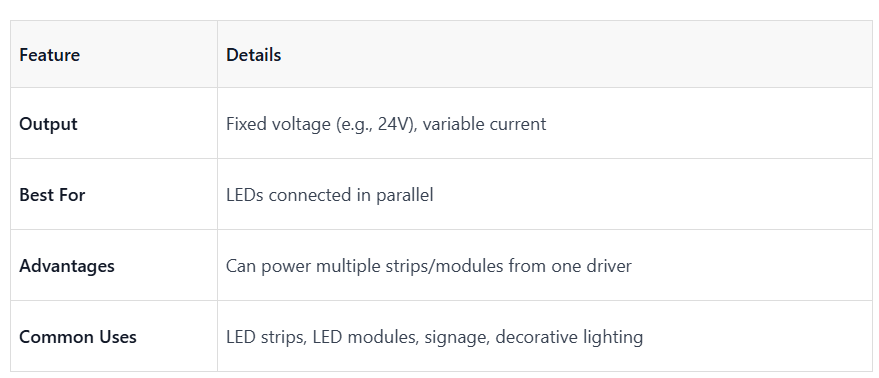
How they work: The driver supplies a constant voltage, and the current is determined by the total load. Each LED strip or module has built-in resistors or internal current regulation to limit current .
Practical Example
Using a constant voltage driver for a 24V LED strip project:
Total load: 5 meters × 4.8W/m = 24W
Required driver: 24V, at least 30W (with 20% margin)
Using a constant current driver for a high-power LED array:
LED configuration: 12 LEDs in series × 3.5V forward voltage = 42V
Required current: 700mA per string × 4 parallel strings = 2.8A
Required driver: Constant current, 48V/150W (with margin)
How to Identify Which One You Need
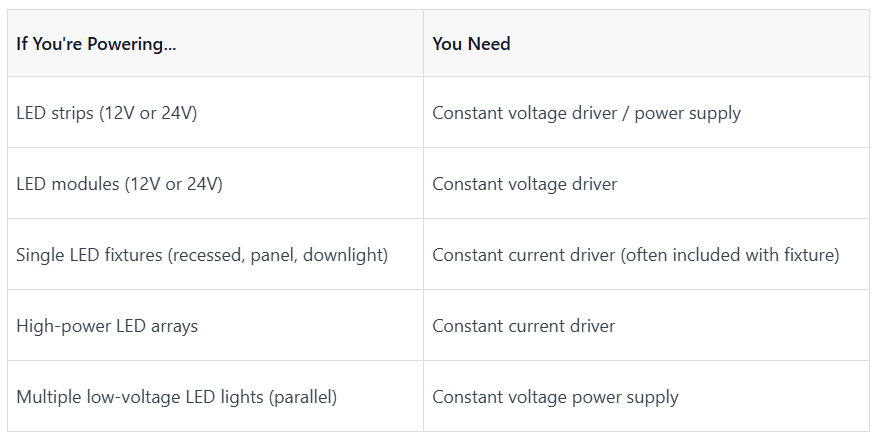
Check the label: The power supply or driver will specify:
"Constant Voltage" or "CV" → Fixed voltage output
"Constant Current" or "CC" → Fixed current output
Voltage range (e.g., 12-24V) → Usually constant current
Fixed voltage (e.g., 24V) → Usually constant voltage
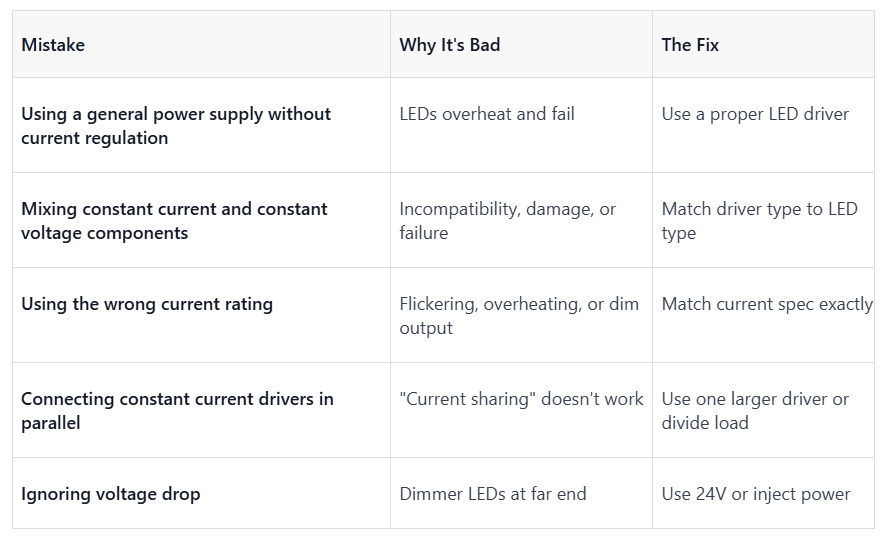
Common Mistakes to Avoid
Key Safety Consideration: Class 2 Compliance
When selecting power supplies or drivers, consider Class 2 standards defined by the National Electrical Code (NEC). A Class 2 power supply is limited to 60V DC, 4A, and 100W (48W at 12V or 96W at 24V) . These limitations reduce shock and fire risk and often simplify permitting and installation.
Specification Template
When ordering an LED driver or power supply, include:
LED Power Supply / Driver Specification
Type: [Constant Current / Constant Voltage / General Power Supply]
Output Voltage: [12V / 24V / 48V / other]
Output Current: [For CC: mA or A required; For CV: total wattage]
Output Power: [Calculated minimum + 20% margin]
AC Input: [100-240V AC / 120V AC / 277V AC]
Dimming: [Non-dimmable / 0-10V / TRIAC / PWM]
IP Rating: [IP20 indoor / IP65 outdoor / IP67 waterproof]
Class: [Class 2 / Class 1]
Certifications: [UL, CE, PSE, CCC, etc.]
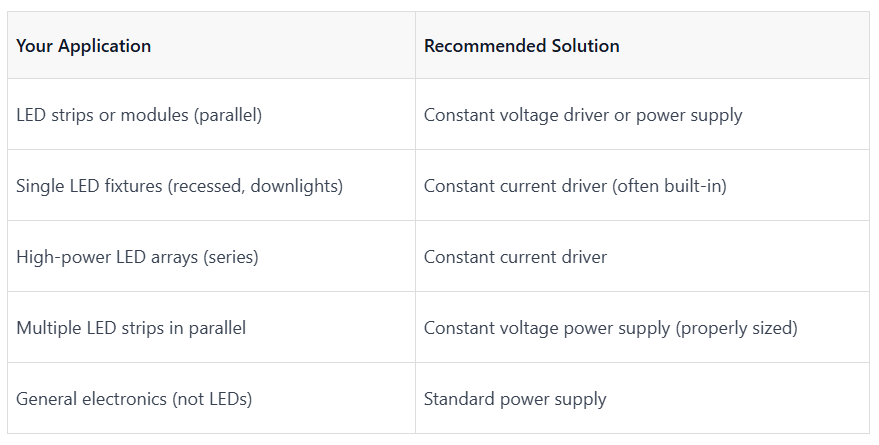
Summary
Related Content
Contact Us
Need help selecting the right driver or power supply for your LED project? Our engineering team can analyze your requirements and recommend the optimal solution.